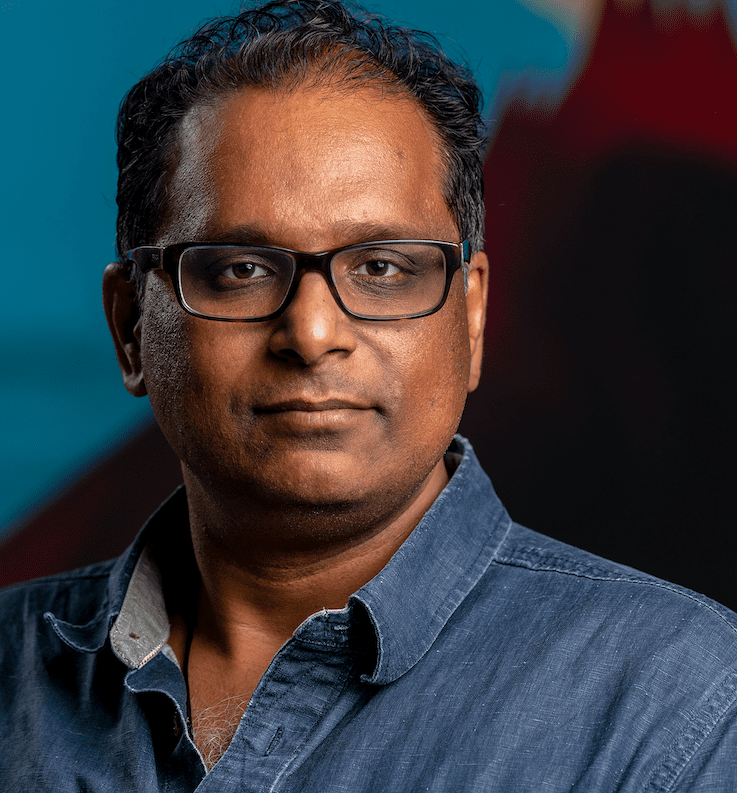
Ram Devineni is a documentary filmmaker and technologist. He is the Founder of Rattapallax, Inc., a not-for-profit organization focused on documentary films, poetry, and transmedia storytelling.
Where did you grow up and what was your childhood like? Did you have any particular experiences/stories that shaped your adult life?
I was born and raised in Eluru in southern India. But moved to New Jersey when I was six years old in 1979. My parents were already in the USA and working as doctors, so they arranged for me and my younger brother to be put on an Air India flight. I remember my grandmother and aunts taking us to the airport and finding a random elderly couple on the same flight to watch out for us. This was the first time both of us left our village and the first time on an airplane. My brother cried the whole time, but I was very stoic. Luckily everything went well and our parents met us at the arrivals gate at JFK Airport. I don’t believe we had much luggage since it was winter, and my parents were going to buy us warmer clothes. I think this solidified my love of spontaneous travel and exploration.
What is something you wish you would’ve realized earlier in your life?
The best form of education is exploration. Everything I learned was from experiencing it in the real world and visiting different cultures.
What are bad recommendations you hear in your profession or area of expertise?
I am not sure it is a bad recommendation, but people are too obsessed with college in order to get a better job. Everything I learned and use now was never taught in college. Experiencing life, different cultures, and being curious about the world is more important to me. College may get you a better job if that is the end goal.
Tell me about one of the darker periods you’ve experienced in life. How you came out of it and what you learned from it?
My problems seem minor compared to the subjects I feature in my art and films. I had dark periods and moments like everyone else, but I get through them because I do not hold any grudges, resentments, or doubts.
What is one thing that you do that you feel has been the biggest contributor to your success so far?
I love collaborating with people when creating art. My strength has always been to think of big ideas and work with others to make them. The creation of the Priya comic book series involved many different people who brought their own experiences and talents to make it happen. Appreciating the work everyone does is equally important because art is not always lucrative, but very rewarding and worthwhile to society. The value we derive from art is immeasurable. I believe the prehistoric cave paintings are the most important testament to our existence.
What is your morning routine?
I get up at 6 am and go to the coffee truck near my building in New York City. I purchase a cup of coffee and two hard-boiled eggs. This is my routine when I am at home, but changes dramatically when traveling abroad. I like watching the sunrise wherever I am.
What habit or behavior that you have pursued for a few years has most improved your life?
Try to take a 30-minute nap sometime during the day. Since I wake up early and go to bed late — naps are essential. That short respite will energize your creative brain. I remember growing up in India, it was bliss taking a nap under the shade of a banyan tree.
What are your strategies for being productive and using your time most efficiently?
I don’t have a formula for being more productive, but I know that creativity is a mess and never linear. So, relax and take long walks to motivate yourself, and eventually, the ideas will come.
What book(s) have influenced your life the most? Why?
In terms of my life experiences and philosophy, that book would be The Hero with a Thousand Faces by Joseph Campbell. His work and focus on comparative religions and mythologies have influenced my understanding of society and how to tell stories. My creative process is also influenced by Zen in the Art of Archery by Eugen Herrigel. Using Zen philosophy in art and filmmaking allows you to remove obstacles and connect directly with your subjects and ideas. Lastly, I love Frank Herbert’s Dune which is a book I return to every few years and read for pleasure. Also, there is an obvious correlation between the mythologies in “Dune” with Joseph Campbell’s work.
Do you have any quotes you live by or think of often?
Mahatma Gandhi famously said, “You must be the change you want to see in the world.”
In my comic book, Priya is a rape survivor who is thrown out of her village and is forced to live in the jungle. She is stalked by a tiger, which represents fear. One day she climbs down from the tree and looks the tiger in the eye and sings a powerful mantra given to her by the Goddess Parvati. “Speak without shame and stand with me and bring about the change you want to see.”
Soon the tiger is transformed into her ally. Fear becomes Shakti or power. She rides the tiger back into town and at first, the villagers are afraid of her because she is riding a tiger, but as they hear her mantra, the townspeople are transformed and join her on a movement to fight the cultural stigmas and patriarchy surrounding rape. Her superpower is the power of persuasion, which is a radical concept in the superhero pantheon.

