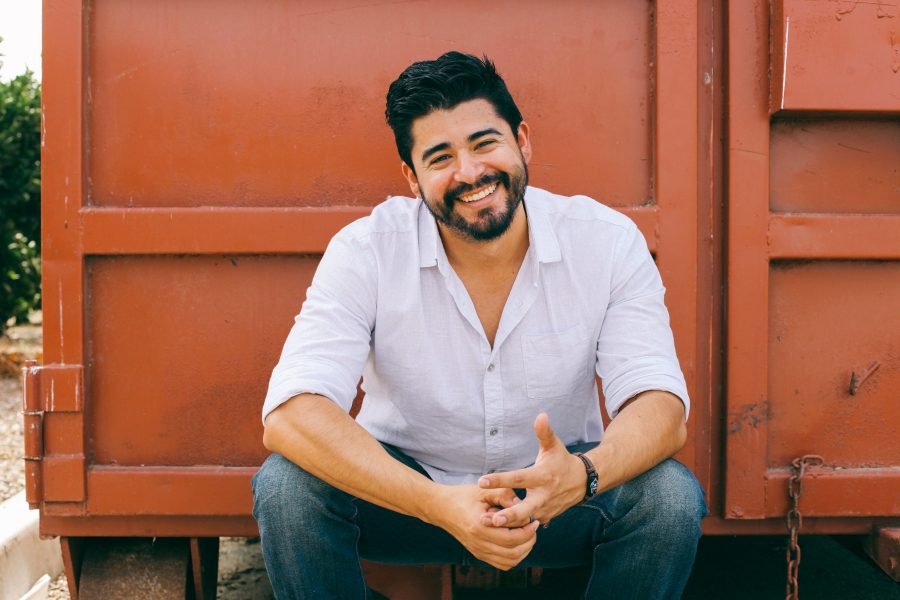
Shawn Callahan is an award-winning author, business storytelling specialist, speaker, and podcast host. He is the author of the bestselling book Putting Stories to Work: Master Business Storytelling. Callahan is the founder and director of Anecdote International, a professional training and coaching company helping leaders, sellers, managers, and everyone involved in the business to influence, engage, and inspire.
Where did you grow up and what was your childhood like? Did you have any particular experiences/stories that shaped your adult life?
I was born in Beaufort, South Carolina, but grew up from the age of five in Canberra, Australia. My father was a US Marine and he was posted to the US Embassy in Canberra where he met my Mum.
When Dad left the Marines, he joined a company that sold commercial kitchens for restaurants and was big on self-development, particularly on how to be a great salesman. So, as a kid, I often spent time in Dad’s car listening to sales training tapes. From an early age, I knew about things like the imminent event close and the assumptive close.
What is something you wish you would’ve realized earlier in your life?
I wish I knew much earlier how to be an entrepreneur. My parents were salaried employees, and everyone I knew in Canberra was the same. On the other hand, a friend of mine is a successful entrepreneur who has created and sold several companies. I saw him take his 25-year-old son under his wing, and they started three businesses together, and now his son is a seasoned entrepreneur at the age of 35. I feel I’m still learning how to do it at 56.
What are bad recommendations you hear in your profession or area of expertise?
The worse advice I hear story experts give is to use Hollywood techniques to become better business storytellers. Business people should leave techniques like the Hero’s Journey and story-boarding to the world of screenwriting.
Tell me about one of the darker periods you’ve experienced in life. How you came out of it and what you learned from it?
This March, we went from a thriving global training business to a company without work in one week. When the COVID-19 pandemic hit all our customers canceled their training, and we had to scramble as fast as we could to create an online version of our story training. Our priority was to look after our people, and I’m pleased to say we kept our entire team throughout the pandemic. Our next task was to create new work when most of our customers had gone to the ground. Instead of heavy marketing and sales, we opted for thinking of ways we could help out and just kept in touch. Eventually, our work came back. Being forced to create a new delivery model helped us innovate. We created new ways for people to learn business storytelling. From here on in we will always have someone online elements to our learning programs.
What is one thing that you do that you feel has been the biggest contributor to your success so far?
I have always been a non-fiction reader. I’m surprised just how many business leaders and consultants don’t read that much. And because I started in academia, I read research papers and learn first hand what the experiments discovered. Customers have told us many times how they appreciate our research-based approach.
What is your morning routine?
At the moment I rise at 6 am. I have a breakfast of muesli and fruit and then walk for an hour with a friend. I shower and dress for the day, starting at about 8.30 am.
When I need to create something like my book, I start the day at 5 am. I wrote about how I wrote Putting Stories to Work, which has been a best-seller and won a couple of awards, you can check it out here.
What habit or behavior that you have pursued for a few years has most improved your life?
In recent years I’ve started meditating. I use the app Headspace. My meditation practice syncs with the busyness in my life: the busier I am, the more I meditate. It keeps me calm.
What are your strategies for being productive and using your time most efficiently?
I’m a firm believer and practitioner of Getting Things Done (GTD). I use OmniFocus to track all my projects and tasks and review them daily as part of my daily shutdown routine. Shutdown for me includes getting my email inbox to zero (I process all my emails into OmniFocus tasks), and looking at what I need to do the next day and what is coming up over the next week.
In addition to GTD, I try and keep my mornings free of meeting and use this time for more extensive activities that require focussed attention.
What book(s) have influenced your life the most? Why?
Four books have had a significant impact on my life.
When I was in my 20s, I started my first business with my dear friend Peter Fox. Our company did three things: wrote guidebooks for national parks; ran a photo library; and did Geographic Information Systems consulting. During that time in the 90s, we discovered Tom Peters’s work and even drove four hours to Sydney to hear him speak. The topic was Liberation Management, and we learned that you didn’t have to do things the way people always did something, and people were everything in business.
At about the same time, I also discovered the work of Edward Tufte and fell in love with producing beautiful materials and conveying information simply and without chart junk.
In the late 90s, I moved to Melbourne to run IBM’s software services business. I knew things were going to get hectic, so I wanted to make the best use of my time. Getting Things Done by David Allen became my productivity guide. It helped me get my commitments out of my head and down on paper so I could use my brain for thinking.
While at IBM, I did a lot of story work as part of the Cynefin Centre for Organisational Complexity. We worked like corporate anthropologists collecting stories in organisations and using them to guide culture change projects. My boss kept telling me back then that storytelling was a dirty word. It was a trifle compared to our anthropological efforts. But somehow I got hold of Annette Simmons’s book on storytelling, The Story Factor, and it hooked me. From that point, I wanted to bring humanity back to business using the full range of story techniques.
Do you have any quotes you live by or think of often?
I often hear myself quoting the statistician George Box who said: “All models are wrong, some are useful.” People can get pretty fixated on their models, and some will talk about them as if they are real. This quote helps to put things into perspective.
People often ask me to help them craft a story of the future. Sure, you can make things up and provide scenarios that might come to pass, but I find that approach is rarely compelling. Instead, I remember a quote attributed to the sci-fi writer William Gibson, “The future is already here, it’s just unevenly distributed.” I like to think in a large organisation the future is already happening; you just have to find it and recount that. Then you can finish your Gibson story by saying, “… and imagine if we can do that everywhere.”