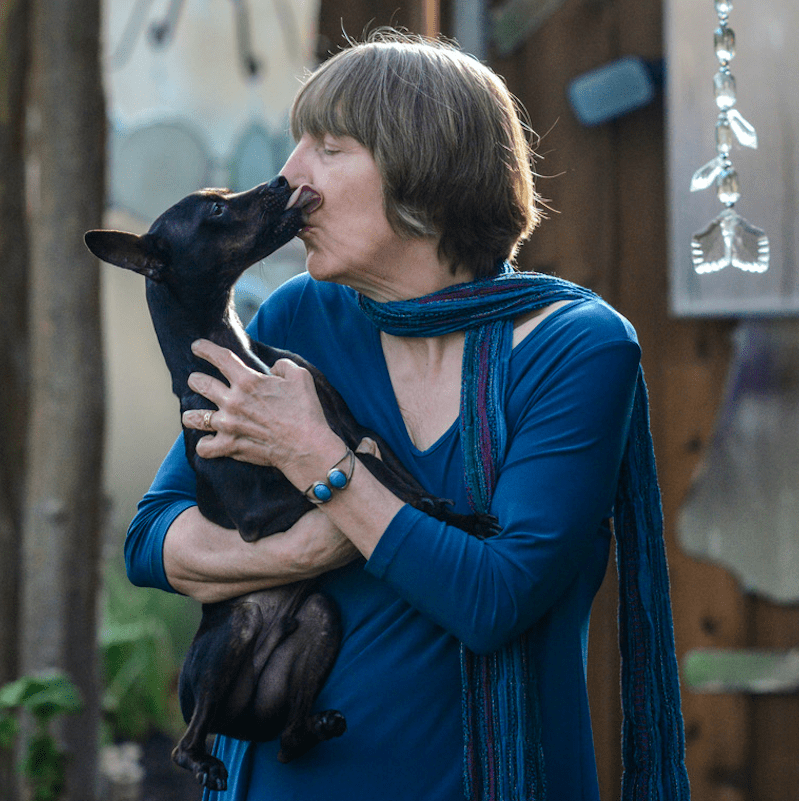
Carol Adams is a feminist scholar and activist whose written work explores the cultural construction of overlapping and interconnected oppressions, as well as the ethics of care. Adams’s first book, The Sexual Politics of Meat, celebrated its 30th anniversary in 2020. She is also the author of Burger, in Bloomsbury’s Object Lessons Series, and co-author with Virginia Messina of Protest Kitchen: Fight Injustice, Save the Planet, and Fuel Your Resistance One Meal at a Time, and of many other books. She is also working on a memoir of her mother based on her essay from the New York Times, Finding Myself in My Mother’s Calendars.
Where did you grow up and what was your childhood like? Did you have any particular experiences/stories that shaped your adult life?
I grew up in a small village with two sisters in a wonderful Victorian house that looks like the Addams Family house, a several-storied brick mansion, with a tower from which we could look at the tops of trees. Many of us in the village had ponies and horses, upon which we played hide and go seek in the woods behind our house, or raced through cornfields, or on a hot summer day, simply lay on the backs of the horses, under a huge willow tree and talked. I know that my relationship with a variety of animals, not just the horses, cats, and dogs in our family, but both wild and domestic animals, influenced me greatly. Animals can help shape a self, and I believe that happened with me. My mother was an activist for farm workers and poor people in our county, my father a lawyer, and we had lively conversations over dinner. We were encouraged to think for ourselves and were feminists from childhood on.
The house-shaped me in many ways—its hugeness and unusual appearance in the village, my parents’ hospitality in opening the house to friends, so that everyone felt comfortable dropping in, and even, the sense that I could dream big—as big as the house.
When one of the ponies was killed as a result of a target practicing in the woods near the pasture, I was 21. That night I went to eat a hamburger and realized I was a hypocrite—I would not eat Jimmy the pony lying dead in the pasture awaiting burial the next day, so who was I to be eating this dead animal? I asked myself, “Was it only animals I don’t know whose deaths I was willing to tolerate?” And so, I became a vegetarian, which lead to realizing there was a connection between eating animals and a patriarchal culture, which lead to writing a book on the subject, and becoming a vegan, and writing other books, and becoming the person I am.
What is something you wish you would’ve realized earlier in your life?
To feel free to make more mistakes. To write every day. To not be afraid of my feelings, that I don’t need to protect my feelings from mourning or grief. We are living in a time when grief is an understandable response. I know now how to say, “Here you are again grief, it is painful, but you remind me of how we are connected, of how much there is to mourn, but that my work is not done; you empower my activism.”
What are bad recommendations you hear in your profession or area of expertise?
That it’s sufficient to go vegan to help change the world and that by going vegan you won’t get ill.
First, I see veganism as a minimum ethical condition—by becoming vegan we help to say no to the cruelty of animal agriculture, we take a stand for protecting the climate, we refuse to support industries that abusively use non-documented and poor people (for instance, the meat producers who took private bets among themselves about how many of their employees would get COVID-19 because the slaughterhouse was such a vector for the disease). But I would never claim that veganism is the only change we need to make; it’s one of the daily things we can do to help improve the world, but it doesn’t relieve us of our need to challenge other forms of social injustice.
Second, veganism is not a magic health bullet and it’s dangerous to believe or promote that it is. Two books I co-wrote address these issues. Protest Kitchen about the links between progressive values and veganism and Even Vegans Die, addressing the issues of believing vegans don’t get ill.
What is one thing that you do that you feel has been the biggest contributor to your success so far?
After having the idea that there was a connection between living in a misogynist culture and our treatment of animals, it took fifteen years to finish my book. I trusted myself that my idea was important. And despite rejections by dozens of publishers, and doubts–even laughter–from friends and acquaintances about the idea, I kept at it. I believed in myself though it was really hard to figure out how to write the book, and sometimes I felt very lonely.
Tell me about one of the darker periods you’ve experienced in life. How you came out of it and what you learned from it?
I was a full-time activist during the 1980s, while also trying to write my book. The challenge that a group of us made against a city for its racism in their housing program brought out racist hostility in the form of an anti-housing group. For complex reasons, they spent a lot of their vitriol on me, discussing me on a local call-in station (a pre Rush Limbaugh kind of person let them do this for hours on end), and in other ways personalizing their attacks. Meanwhile, the housing was blocked. For several years it was very hard because I felt that I was a good person and I hated being hated, while also trying to strategize how to get the housing built.
I thought of the theologian Paul Tillich’s The Courage to Be, and I interpreted it in this way: all I needed when I began was the courage to take the first step. In taking that first step of responding to the injustice in my city, I became the person who could take the next step and then the one after that. We grow in courage, like steel being tempered in heat, as we take a stand and see our commitment through.
Right now, we need lots of activists who recognize the tentacles of white supremacy and will challenge it. I’d like to think this idea about the courage to be, that courage grows, as we learn from challenging injustice, might help others take those first steps.
And we won our battle—we were able to get the housing built, got financial support for minority homeowners, and also challenged the license of that radio station and prevailed.
What is your morning routine?
Waking up varies; in the summer months, I’m up with the sunrise and I do what I laughingly call my “mini-triathlon.” I walk the two rescue dogs that live with us, bike for an hour, and swim about half a mile. (It’s Texas—and the first two activities have to be done early in the day.) In the non-summer months, I usually get up around 7 or 7:30, and most mornings I write in my journal, read poetry, read literary essays, follow ideas, and then emerge from the room where I do this, ready for the day!
Last year, during the winter months, I followed that practice by working my way through forty years of my mother’s calendars. I am very proud of the piece I wrote for the New York Times about her calendars, and I can’t tell you how many incredible responses I got to it. I think my morning routine was integral to freeing me into the creative space to write it. https://www.nytimes.com/2019/08/17/opinion/sunday/my-mothers-calendar-memory.html
What habit or behavior that you have pursued for a few years has most improved your life?
Keeping a journal. It’s a gift that keeps on giving.
What are your strategies for being productive and using your time most efficiently?
As a writer, I need to avoid the distractions of social media and the anxiety of FOMO. I use Freedom to help me. I commit to working three hours entirely focused on my next project, and tell Freedom to block my internet access for that amount of time. While I know I could cheat and check my phone (which Freedom could also block), somehow the mental commitment isn’t hard to keep.
I have also had to learn to say “no” to some things which are really hard, but I know if I don’t value my time how will anyone else.
I set deadlines for myself, which builds in accountability—if I don’t meet the deadline I have to examine what caused me to fail, and be honest about it. If I continually miss my own deadlines I have to ask, “Are you actually committed to this project?”
And I know to write an idea down when I have it. I have come to see any idea as a gift, and I should accept it when it appears. By not writing it down (and instead of telling myself, “I will remember it”) whatever creative moment I am having shuts down
What book(s) have influenced your life the most? Why?
I am a voracious and omnivorous reader, and over the decades, different books have had roles in influencing my life. I read the poetry of Rilke in my twenties, especially the poem, The Archaic Torso of Apollo by Rainer Maria Rilke—that ends “there is no place/that does not see you. You must change your life” and this invitation/command has accompanied me ever since—not only that we can, but we must be aware of how we can change. We are never done changing. Other poets, from Adrienne Rich to Claudia Rankine, from Gwendolyn Brooks to Molly Peacock, Amy Newman, Kathryn Kirkpatrick, and Terrance Hayes, expand my senses, provide a foundation to ordering my thoughts lyrically, and inspire me in so many ways.
In the 1980s, when I was involved in trying to desegregate a city’s housing and experienced the fury of racists, I read everything I could on the Civil Rights Movement to help me try to understand what was happening in this northern city I lived in. That history was inspiring and so troubling, as I recognized the stranglehold of white supremacy on supposedly democratic institutions.
When I was working on The Sexual Politics of Meat, I was given The Madwoman in the Attic by Sandra Gilbert and Susan Gubar which opened an entirely new way of thinking about women writing. This liberated me to write the book I needed to write.
I have heard from many readers over the thirty years that reading The Sexual Politics of Meat changed their lives, and I am very grateful that they reach out to tell me this. I feel as though it is like a grown child writing home and telling me what they have been up to—this time it’s a book I wrote, out there in the world letting me know how it’s doing. And so, I have to say, that my own book also changed my life—not just in the writing, but in its reception and all the wonderful people I have met through it! And this was something I never anticipated.
Do you have any quotes you live by or think of often?
The quote that I used as an epigraph in The Sexual Politics of Meat, from a letter that Virginia Woolf wrote on Christmas Day, 1922. She is talking about what one can accomplish, what she can accomplish in her fiction, but I find it a hopeful declaration, that we must continue to do the work we are called to do, not to renounce, but to hope to catch a glimpse of the reorientation of the human spirit.
It is not possible now, and never will be, to say I renounce. Nor would it be a good thing for literature were it possible. This generation must break its neck in order that the next may have smooth going. For I agree with you that nothing is going to be achieved by us. Fragments—paragraphs—a page perhaps: but no more. . . . The human soul, it seems to me, orientates itself afresh every now and then. It is doing so now. No one can see it whole, therefore. The best of us catch a glimpse of a nose, a shoulder, something turning away, always in movement. Still, it seems better to me to catch this glimpse.

